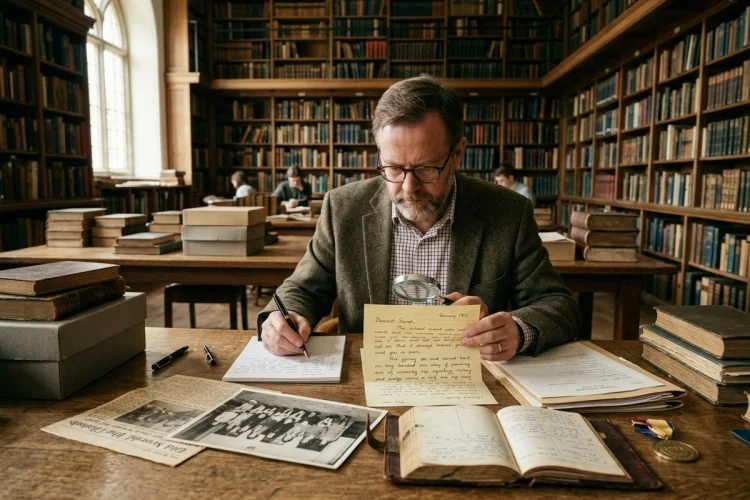
Imagine trying to understand what happened at a school event 50 years ago. You cannot travel back in time and watch it yourself.
Instead, you might search for photographs, letters, newspaper reports, diaries, school records, objects, or interviews with people who were there.
Historians face a similar challenge on a much larger scale. Learning how historians use evidence to understand the past means understanding how they collect, question, compare, and interpret traces left behind by earlier people and societies.
The Library of Congress describes primary sources as the “raw materials of history”-original documents and objects created during the period being studied. Secondary sources, by comparison, analyze or interpret historical events later.
However, historians do not simply find an old document and assume everything in it is true. They ask who created it, why it was created, what was happening at the time, and how it compares with other evidence.
History, in other words, works a little like detective work-but with plenty of careful questioning.
1. Historians Begin With Questions
Historical research usually begins with a question rather than a collection of random facts.
A historian might ask:
Why did people migrate from one region to another?
How did a war affect ordinary families?
What caused public attitudes toward a law to change?
The question determines what kind of historical evidence will be useful. A researcher studying daily life during a war might examine letters, photographs, ration records, newspapers, government documents, and personal diaries.
Historical thinking is not simply about memorizing dates. The American Historical Association explains that historians use ideas such as context, change over time, and causality to develop explanations of past events.
Because historians cannot recreate past conditions experimentally, their arguments rely on interpreting surviving evidence.
A focused question therefore gives historical investigation direction.
2. Primary Sources Provide Direct Evidence From the Past
One of the most important types of historical evidence is the primary source.
Primary sources were created during the time being studied or by people directly connected with an event. The Library of Congress includes original documents and objects within this category.
They can take many forms.
A diary written by a soldier, a photograph of a protest, a government census, an old map, a political poster, a recorded speech, or a piece of clothing can all become historical evidence.
The Smithsonian Archives gives examples including birth certificates, photographs, diaries, letters, clothing, household objects, newspapers, and eyewitness testimony.
This variety matters because the past was experienced by real people in many different ways.
A government report might tell historians what officials wanted to record, while a personal letter could reveal how an individual experienced the same event.
Neither source automatically tells the whole story.
3. Secondary Sources Help Explain and Interpret Evidence
Historians also use secondary sources.
These include works created after an event that analyze, explain, or interpret historical evidence. Books written by historians, academic articles, and some documentaries may function as secondary sources.
The Library of Congress distinguishes these from primary sources because secondary accounts generally retell, analyze, or interpret events from a later time or place.
Secondary sources can be extremely useful.
Suppose you are researching the Industrial Revolution. Reading a historian’s book may help you understand important dates, economic changes, major debates, and relevant primary sources before you begin examining individual factory records.
However, secondary sources are also interpretations.
Two historians may examine much of the same evidence but emphasize different causes or consequences. The American Historical Association notes that historical arguments are based on partial evidence that can sometimes support multiple explanations.
That is one reason historians continue debating events that happened centuries ago.
4. Historians Ask Who Created a Source and Why
Finding an old document is only the beginning.
Historians next ask questions about its source and purpose.
Who created it?
When was it created?
Who was supposed to read or see it?
Why was it produced?
The National Archives recommends exactly this kind of document analysis. Its historical analysis tools ask readers to identify the author, audience, date, place, purpose, and historical circumstances surrounding a document before using it as evidence.
Imagine finding a political poster claiming that a government policy has been an enormous success.
That poster provides useful evidence-but perhaps not straightforward evidence that the policy actually succeeded.
Instead, it may provide evidence about what the government wanted citizens to believe.
Understanding purpose changes how historians interpret a source.
5. Historical Context Changes the Meaning of Evidence
A document cannot always be understood properly when separated from the world in which it was created.
That is why historians use contextualization.
They ask what was happening politically, socially, economically, and culturally when the source appeared.
The National Archives encourages researchers to ask what was happening at the time a document was created.
The Digital Inquiry Group similarly identifies contextualization as one of the major skills used when reading historical documents, alongside sourcing, corroboration, and close reading.
Imagine reading a newspaper article criticizing food shortages.
Without context, it may sound like a simple complaint.
But if you discover that the article appeared during a major war when shipping routes had been disrupted, the document takes on additional meaning.
Context does not replace the source. It helps explain it.
6. Historians Look for Perspective and Bias
Every historical source comes from a particular perspective.
A wealthy landowner and a farm worker might describe the same economic crisis very differently. A general’s report about a battle might emphasize achievements while a private soldier’s diary focuses on fear and confusion.
Perspective does not automatically make a source useless.
Instead, historians ask how the creator’s background, goals, experiences, beliefs, and position may have influenced what was recorded.
The National Archives specifically teaches readers to examine how people’s backgrounds, beliefs, and experiences shape their points of view.
It also notes that working with primary sources helps readers recognize bias, contradictions, limitations, and questions of reliability.
This produces a more useful question than simply asking:
“Is this source biased?”
Historians are more likely to ask:
“How might this perspective have shaped what the source tells us?”
7. One Source Is Usually Not Enough
Imagine investigating a protest using only a report written by the police.
You would learn something useful—but only from one perspective.
Now add newspaper photographs, statements from protesters, government correspondence, eyewitness accounts, video footage, and later interviews.
The picture becomes more detailed.
Historians use corroboration to compare evidence from different sources. The Digital Inquiry Group identifies corroboration as a core historical reading skill alongside sourcing and contextualization.
When independent sources support the same detail, historians may have greater reason to accept it.
When sources disagree, the disagreement itself becomes something to investigate.
Perhaps the writers had different information. Perhaps they witnessed different parts of an event. One may have had reasons to exaggerate or hide something.
Historical disagreement does not necessarily make research impossible. It often provides important clues.
8. Objects Can Be Evidence Too
Historical evidence is not limited to written documents.
Buildings, tools, clothing, coins, artworks, photographs, furniture, weapons, household objects, and other artifacts can reveal information about past societies.
The Smithsonian describes primary sources as evidence historians use to investigate people, events, and everyday life, and its collections include historical artifacts alongside photographs, archival records, books, manuscripts, audio, and moving images.
Imagine archaeologists discovering cooking tools inside an old settlement.
The objects may reveal information about food preparation, available materials, trade, technology, or household life even if the people who lived there left few written records.
Combining artifacts with documents can be especially powerful.
A written law might tell historians what authorities officially required, while physical evidence could help reveal what people actually did.
9. Historians Build Arguments From Evidence
Eventually, historians have to move from collecting evidence to explaining what it means.
This is where historical interpretation becomes important.
Suppose several sources show that thousands of people left a region during a particular decade. The historian still needs to explain why.
Was migration mainly caused by unemployment?
Political conflict?
Environmental change?
New opportunities elsewhere?
Different pieces of evidence may support several factors.
Historians develop arguments by deciding which explanations are best supported by the available evidence.
The American Historical Association emphasizes that historians construct explanations by interpreting partial primary sources, often while considering more than one possible explanation.
A strong historical argument therefore does not simply say:
“This happened.”
It explains:
“This is our best interpretation of why it happened, based on this evidence.”
10. Historical Conclusions Can Change
History is about the past, but historical knowledge is not permanently frozen.
New documents may be discovered. Archives may become available. Archaeological evidence may appear. Researchers may also ask new questions of sources that historians have known about for decades.
Historical interpretations can therefore change.
The American Historical Association describes historical thinking as a process that involves assessing competing views, seeking corroboration, considering bias, and remaining open to revising conclusions.
Changing an interpretation does not necessarily mean earlier historians knew nothing.
Sometimes new evidence changes the balance of the argument. In other cases, historians examine familiar evidence from a different perspective and notice people or experiences that earlier research overlooked.
That makes history an ongoing investigation rather than a completed list of facts.
Understanding how historians use evidence to understand the past shows that history involves much more than remembering names and dates.
Historians begin with questions, examine primary and secondary sources, investigate context and perspective, compare multiple accounts, and build interpretations supported by evidence.
No single source usually tells the entire story. A letter may reveal one person’s experience, a government record another perspective, and an artifact something that neither writer mentioned.
By comparing these clues, historians can build a more complete picture while remaining aware that some uncertainty may always remain.
You can practice the same skill yourself. Choose an old photograph, newspaper article, letter, or family object and ask who created it, when, why, and what it can genuinely tell you.
The past cannot speak for itself-but careful evidence helps us listen more closely.