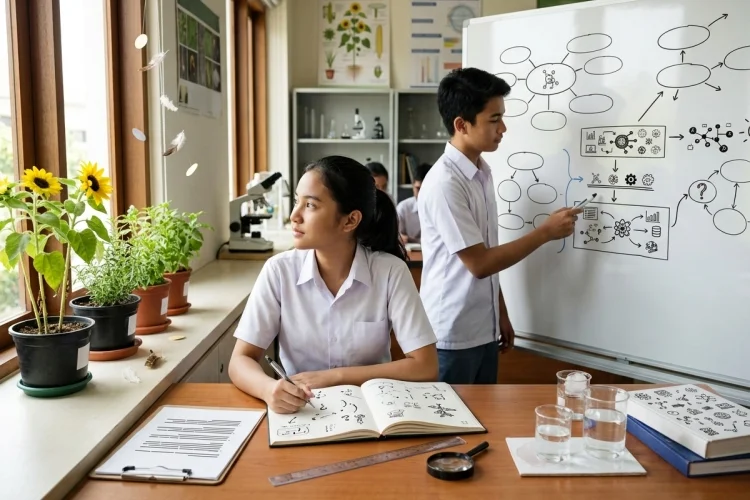
Almost every scientific investigation begins with curiosity. You notice that one plant near a window grows faster than another, ice melts differently in certain places, or some objects seem to fall differently in moving air. The first reaction is often simple: “Why is that happening?”
That curiosity is valuable, but a good scientific investigation needs a question that is more focused. Learning how to ask clear scientific questions for an investigation means turning a broad idea into something you can observe, measure, compare, or test.
The Next Generation Science Standards treat asking questions as a core science and engineering practice. As students progress, they are expected to move from simple questions based on observations toward questions that can be investigated empirically.
A strong investigation question gives the rest of your project direction. It helps you decide what data to collect, which variables matter, and what kind of evidence could answer the question.
Here is how to create one step by step.
1. Start With Something You Can Observe
Good scientific questions often begin with an observation.
Imagine that you place two wet towels outside. One is in direct sunlight and the other is in the shade. After an hour, you notice that the sunny towel feels drier.
You might begin by asking:
“Why did one towel dry faster?”
That is a useful starting point because it comes directly from something you observed.
Scientific inquiry frequently begins when people notice patterns, differences, unexpected events, or unexplained phenomena. NGSS guidance encourages students to ask questions based on observations and use them to learn more about the natural or designed world.
You can find possible investigation topics almost anywhere.
Plants growing near windows, different materials absorbing water, food cooling at different rates, shadows changing during the day, or objects moving across different surfaces can all generate questions.
At this stage, do not worry about creating the perfect question. Write down what makes you curious first.
2. Turn a Broad Question Into a Specific One
Curiosity often produces questions that are too broad to investigate easily.
Consider:
“What makes plants grow?”
This is scientifically interesting, but many factors can influence plant growth, including water, light, nutrients, temperature, species, soil conditions, and time.
A clearer question might be:
“How does the amount of daily light affect the height of bean plants over three weeks?”
Now the investigation has clear boundaries.
NASA JPL suggests helping students develop testable science-fair questions using a simple structure:
How does INPUT affect OUTPUT?
That pattern can be surprisingly useful.
For example:
How does water temperature affect how quickly sugar dissolves?
How does ramp height affect the distance a toy car travels?
How does the amount of sunlight affect plant growth?
The more specific the question becomes, the easier it is to design an investigation around it.
3. Make Sure the Question Can Be Tested With Evidence
Not every interesting question is suitable for a simple scientific investigation.
For example:
“Which flower is the most beautiful?”
The answer depends heavily on personal preference. There is no obvious measurement that can objectively determine “most beautiful.”
Compare that with:
“Which of three flower species attracts the greatest number of bees during a 30-minute observation?”
Now you can collect evidence by counting bee visits.
A good scientific investigation question should lead to observations or measurements that can help answer it.
Science Buddies recommends checking whether important variables can be measured using quantities such as counts, percentages, lengths, weights, time, temperature, or other observable measures.
The American Museum of Natural History similarly explains that scientists use hypotheses and predictions that can be tested through investigation.
Ask, “What Data Would Answer This?”
This is a useful test.
Take your proposed question and imagine the final results.
What would you measure?
Would you record time?
Height?
Temperature?
Number of objects?
Distance traveled?
If you cannot imagine what evidence would answer the question, it may still be too vague.
4. Identify What You Will Change and Measure
Many experiments involve variables.
The independent variable is the factor deliberately changed, while the dependent variable is what you measure or observe as a result. Other relevant conditions may need to be kept consistent so that the comparison remains meaningful.
Consider:
“How does water temperature affect the time needed for a sugar cube to dissolve?”
Independent variable:
Water temperature
Dependent variable:
Time taken for the sugar cube to dissolve
You might then keep other conditions similar, such as the amount of water, size of the sugar cube, container type, and stirring method.
Recognizing these variables can help you check whether your original question is clear.
If you cannot tell what is changing and what is being measured, rewrite the question.
For example:
Too vague:
“Does water change sugar?”
Clearer:
“How does water temperature affect the time required for 5 grams of sugar to dissolve?”
The second question gives you a much clearer plan.
5. Keep the Investigation Manageable
A scientific question can be testable but still be unrealistic for a school investigation.
Imagine asking:
“How does global temperature affect every species on Earth?”
That is far beyond what one student can reasonably investigate.
A better question might be:
“How does temperature affect the activity of mealworms during a ten-minute observation?”
The topic is now small enough to investigate directly.
A manageable question should fit the resources, time, equipment, safety conditions, and access available to you.
NASA JPL’s science-project guidance encourages students to develop questions they can actually test and then design repeated trials around the chosen variable.
You should also think practically.
Can you obtain the materials?
Can you collect enough measurements?
Can you repeat the investigation?
Can you complete it within your deadline?
A narrower experiment often produces better evidence than an enormous question with no realistic way to collect reliable data.
6. Design the Question for a Fair Comparison
Suppose you want to investigate whether fertilizer affects plant growth.
You place one plant with fertilizer beside a sunny window and another plant without fertilizer inside a dark cupboard.
If the first plant grows faster, what caused the difference?
Was it fertilizer?
Or light?
Because two major conditions changed, the answer becomes difficult to interpret.
For many controlled experiments, a fair comparison means changing the factor you want to investigate while keeping other important conditions as similar as practical.
Science Buddies describes a basic fair test as changing one factor at a time while keeping relevant conditions consistent.
So your question might be:
“How does the amount of fertilizer affect the height of bean plants grown under the same light and watering conditions?”
This wording encourages a cleaner investigation.
However, remember that not every scientific investigation is a controlled laboratory experiment. Scientists may also use field observations, models, surveys of natural phenomena, or existing datasets depending on the question.
National Academies materials describe students using evidence from investigations and relevant resources to construct and evaluate scientific explanations.
The method should fit the question.
7. Avoid Questions That Already Assume the Answer
Scientific questions should leave room for evidence to surprise you.
Consider:
“Why does sunlight make plants grow much better?”
The wording already assumes that sunlight will produce a particular result.
A more neutral question would be:
“How does the duration of daily light exposure affect the growth of bean plants?”
Now several outcomes are possible.
More light could increase growth, reduce it under certain conditions, or produce little difference within the tested range.
That uncertainty is useful.
Science is not about designing an experiment to prove the answer you already want. The goal is to collect evidence that helps evaluate an explanation or prediction.
National Academies guidance emphasizes using data as evidence to support, refine, or challenge explanations and claims.
Try removing loaded words such as better, worse, best, or obviously unless you clearly define what they mean.
Replace “better” with something measurable such as taller, faster, heavier, cooler, stronger, or more frequent.
8. Test Your Question Before Starting the Investigation
Before gathering materials, give your scientific question one final check.
Suppose your question is:
“How does the color of light affect plant growth?”
Ask yourself what plant growth means.
Plant height?
Number of leaves?
Total mass?
Growth rate?
Changing the question to:
“How does red, blue, or white light affect the height of bean seedlings after 14 days?”
makes your measurement much clearer.
Science Buddies recommends checking whether variables are measurable and whether relevant controlled conditions have been identified before beginning an experiment.
You should also check whether the wording connects logically with the planned procedure.
If your question asks about temperature but your experiment never measures or changes temperature, something is wrong.
A useful final template is:
How does [independent variable] affect [measurable dependent variable] under [important conditions]?
You do not need to force every investigation into that exact sentence structure, but it is an excellent starting point for beginner experiments.
Once the question is clear, you can move on to background research, predictions, investigation design, data collection, and analysis.
Learning how to ask clear scientific questions for an investigation begins with curiosity, but it requires more than simply asking “why?” A useful question should be specific enough to investigate, connected to observable evidence, and realistic within the time and resources available.
For many experiments, identifying the independent and dependent variables helps clarify exactly what will change and what will be measured. Good questions should also avoid assuming the result before evidence has been collected.
Most importantly, treat the first version of your question as a draft. Scientists refine questions as they learn more about a problem, and NGSS explicitly describes scientific questioning as a process that develops toward formulating and evaluating testable questions.
Start with one observation today and ask: “What could I change, what could I measure, and what evidence would answer my question?”