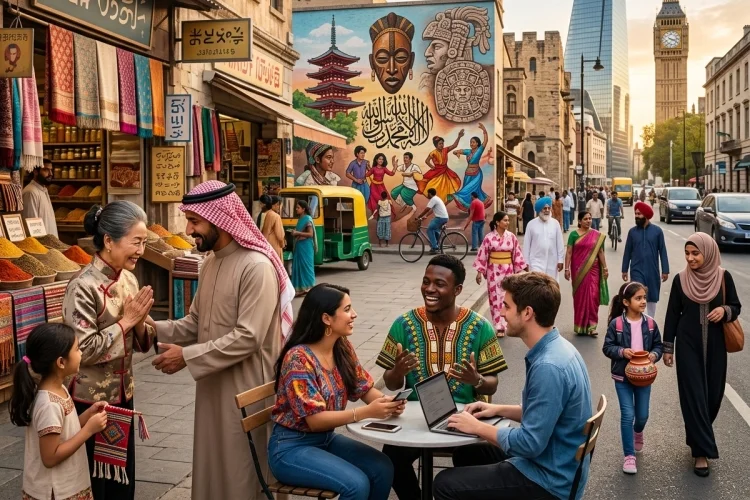
Think about something as ordinary as greeting another person. In one community, a handshake may feel completely natural.
Somewhere else, people may bow, hug, kiss a cheek, use a particular title, or simply smile and speak politely. None of these behaviors appears automatically at birth. People learn them by living with others.
Understanding how culture shapes language, traditions, and daily life helps explain why communities around the world can approach food, communication, celebrations, family roles, clothing, work, and social behavior in different ways.
Culture includes shared ideas, practices, values, symbols, knowledge, and expectations that people learn and pass between generations.
Anthropologists emphasize that culture is learned rather than biologically inherited, while cultural frameworks help people understand which behaviors and forms of communication are appropriate in particular situations.
Culture is not frozen in time, either. It changes as people migrate, communicate, adopt technologies, exchange ideas, and respond to new conditions.
That makes culture something we inherit, practice, negotiate, and continually reshape.
1. Culture Gives Everyday Behavior Meaning
Many things we do each day feel completely normal because we have practiced them for years.
How close should you stand while talking to someone? When should you arrive for dinner? Should younger people address older people by their first names? Is eating together an important family activity?
The answers can depend partly on cultural expectations.
OpenStax describes cultural frames as shared ways people make sense of particular situations. These frameworks can influence what roles people expect to play and which types of behavior or speech seem appropriate in a given context.
This does not mean everyone from the same culture behaves identically. Age, family background, region, personality, occupation, religion, education, and many other influences can create enormous variation within a society.
Culture is better understood as a collection of shared patterns and meanings than as a strict instruction manual.
That distinction helps us avoid stereotypes while still recognizing that communities often develop recognizable social practices.
2. Language Reflects Cultural Experience
Language is one of the clearest ways culture becomes visible.
People use words not only to exchange information but also to express relationships, humor, politeness, identity, history, and belonging.
Linguistic anthropology studies this close relationship between language and sociocultural life. OpenStax notes that languages vary in ways connected with environmental, historical, and sociocultural conditions.
Consider greetings.
English speakers might ask, “How are you?” In another language, a common greeting may refer to food, family, health, work, or where someone is going.
Different languages can also contain culturally important words that do not translate neatly into a single English word.
The Way We Speak Can Signal Relationships
Vocabulary is only part of the story.
The way people address parents, teachers, elders, strangers, friends, or employers may communicate respect and social distance.
Some languages use different pronouns or speech levels depending on the relationship between speakers. Others communicate respect through titles, vocabulary choices, or indirect phrasing.
The United Nations has emphasized that language touches family life, work, education, politics, media, and many other areas while carrying knowledge, values, identities, and worldviews.
Language is therefore not separate from culture. It is one of the main tools through which culture is expressed and shared.
3. Traditions Carry Knowledge Across Generations
A tradition does not have to be an enormous national festival.
It can be a family recipe, storytelling practice, craft technique, dance, song, ceremony, seasonal activity, or method of preparing food.
UNESCO describes intangible cultural heritage as practices, knowledge, skills, and expressions that communities recognize as part of their heritage. Its importance lies partly in the knowledge and skills transmitted from one generation to another.
Imagine a grandparent teaching a child how to prepare a traditional dish.
The child is learning more than ingredients.
They may also hear stories about where the recipe came from, when it is usually served, which relatives prepared it in the past, and why certain ingredients matter.
One activity can therefore carry practical knowledge, family memory, language, and identity at the same time.
The Smithsonian similarly studies living traditions through areas such as foodways, celebrations, music, occupations, customs, and skills that form part of everyday experience.
4. Food Shows How Culture Enters Daily Life
Food is one of the easiest places to see culture at work.
What people eat can be influenced by climate, agriculture, history, trade, religion, available ingredients, migration, and family traditions.
But culture shapes more than the menu.
It can influence when people eat, who eats together, whether meals are shared from common dishes, how guests are served, and which foods are connected with celebrations.
A recipe can even tell a story about cultural contact.
Ingredients may have traveled between continents through trade or migration before becoming so familiar that people now consider them part of local cuisine.
Smithsonian Folklife specifically treats foodways alongside music, language, craft, celebrations, and other living cultural traditions.
That makes the kitchen a surprisingly useful place to study history and cultural identity.
The next time you eat a familiar family dish, ask where the ingredients originated and why your family prepares it in that particular way.
You may discover a much bigger story.
5. Culture Influences Social Rules and Expectations
Every community develops expectations about social behavior.
Some are formally written into laws or institutional rules. Others exist as informal norms that people learn simply by participating in society.
OpenStax explains that culture is learned and that many everyday human behaviors are shaped through social experience rather than inherited biologically.
For example, cultures may differ in expectations surrounding punctuality, hospitality, personal space, gift giving, table manners, clothing, or how openly people express disagreement.
Even silence can have different meanings.
In one context, remaining quiet may communicate respect. In another, it may be interpreted as uncertainty or lack of participation.
These differences can sometimes create misunderstandings when people from different backgrounds interact.
That is why intercultural understanding involves more than learning a list of customs. It requires recognizing that behaviors that feel “obvious” to us may actually be habits we learned from our own surroundings.
UNESCO argues that understanding the living heritage of different communities can encourage intercultural dialogue and respect for different ways of life.
6. Celebrations Help Communities Express Identity
Festivals and celebrations often bring many cultural elements together at once.
Language, music, clothing, food, dance, storytelling, religious practices, family relationships, and community history may all appear within one event.
That is one reason celebrations can become powerful expressions of identity.
The Smithsonian Folklife Festival, for example, focuses on contemporary living cultural traditions and the people and communities who practice and sustain them.
Celebrations can also teach younger generations what a community considers meaningful.
Children may learn songs, stories, recipes, greetings, rituals, or crafts by participating alongside older relatives and community members.
At the same time, traditions can evolve.
A festival celebrated by people who migrate to another country may gradually incorporate new foods, languages, music, or practices from the new environment.
That does not necessarily make the tradition less authentic.
Living culture survives partly because communities continue interpreting and adapting it.
7. Culture Changes Through Migration and Cultural Exchange
Cultures have never existed in completely sealed boxes.
People travel, trade, migrate, marry, study, work, communicate, and exchange ideas.
These encounters can influence language, food, clothing, music, architecture, and countless other aspects of everyday life.
You can often hear this history inside language itself. Languages borrow words from one another, especially when communities exchange technologies, foods, ideas, and institutions.
Food provides another easy example.
A dish associated strongly with one region today may include ingredients that originally arrived through long-distance trade or migration.
UNESCO describes culture as being in constant change across time and space, adapting as communities encounter new circumstances and exchange knowledge.
Cultural exchange therefore does not always mean one culture simply replaces another.
People frequently combine influences in new ways.
A family may speak one language with grandparents, another at school, cook dishes from several traditions, and listen to music from around the world.
Modern cultural identity can be layered rather than singular.
8. Technology Is Changing How Culture Is Shared
For much of history, cultural knowledge often traveled through face-to-face teaching, storytelling, apprenticeship, ceremonies, or local community life.
Those methods still matter, but digital technology has added new possibilities.
A traditional musician can upload performances online. Families living in different countries can celebrate together through video calls. Language communities can create digital dictionaries, lessons, podcasts, and archives.
The United Nations has highlighted digital projects aimed at supporting minority and endangered languages while also noting the broader relationship between digital technologies and cultural diversity.
Social media can also accelerate cultural exchange.
A dance, recipe, expression, or fashion style can spread internationally within days.
However, digital sharing can remove practices from their original context. People may imitate a cultural element without understanding its history or significance.
This makes cultural literacy increasingly important online.
Instead of asking only, “Where did this trend come from?” we can also ask, “What does it mean to the community that created it?”
9. Language and Traditions Help Preserve Cultural Identity
When traditions disappear, communities may lose more than individual songs or ceremonies.
Knowledge can disappear with them.
UNESCO emphasizes that intangible heritage carries knowledge and skills transmitted between generations, while language can be an important vehicle through which living heritage remains active.
This makes language preservation especially important.
Stories, environmental knowledge, oral histories, humor, songs, and cultural concepts may be difficult to transfer completely into another language.
The relationship works in both directions.
Culture gives language subjects, meanings, expressions, and contexts, while language gives communities a way to communicate and transmit culture. The UN has described languages and cultures as deeply intertwined and mutually enriching.
Preservation does not necessarily mean preventing all change.
Communities can continue adapting while deciding which practices, languages, stories, and skills they want future generations to inherit.
Understanding how culture shapes language, traditions, and daily life helps explain why everyday activities can carry much deeper meanings than we first notice.
Culture influences how people communicate, celebrate, prepare food, interact with others, pass on knowledge, and understand their place within a community.
Language and traditions play especially important roles because they allow cultural knowledge to move between generations. At the same time, culture is always evolving through migration, technology, cultural exchange, and changing social conditions.
Learning about cultural differences should not be about reducing communities to stereotypes. It should encourage curiosity about the experiences and histories behind different practices.
Start with your own daily routine. Pick one greeting, meal, celebration, or family tradition and ask where it came from-you may discover culture hiding in something you have always considered ordinary.