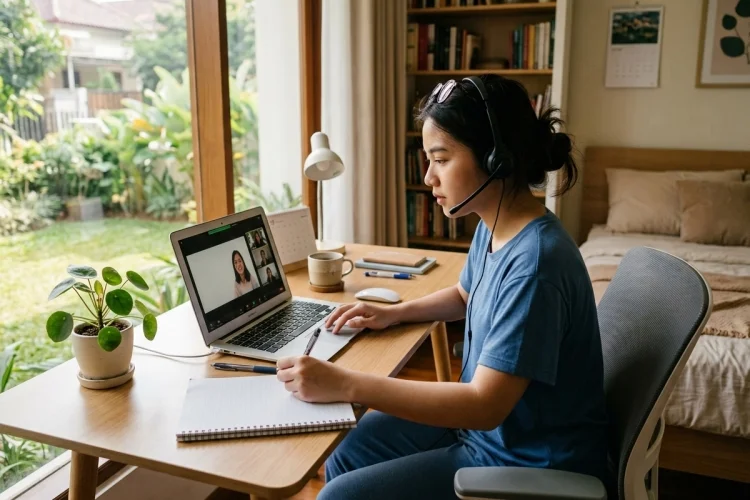
Online lessons can make learning incredibly convenient. You can join a class from your bedroom, replay recorded explanations, access digital resources instantly, and organize study time around other responsibilities.
Yet learning from home also comes with a unique challenge: the same computer used for school can open social media, videos, games, and dozens of other distractions within seconds.
That is why understanding how to learn effectively through online lessons at home involves more than simply logging into class. Successful online learning requires structure, active participation, time management, and regular checks of what you actually understand.
Cornell University’s Learning Strategies Center explains that effective online learning requires students to stay engaged with their coursework, instructors, and classmates rather than simply watching videos and completing tests.
The good news is that you do not need a complicated productivity system. A few practical changes to your environment and study routine can make online lessons feel more organized, focused, and useful.
1. Create a Regular Place for Online Learning
Studying from bed may feel comfortable, but comfort can easily turn into scrolling, snacking, or accidentally falling asleep.
Try creating a regular study area instead. It does not need to be a separate home office. A corner of a table, a small desk, or another reasonably quiet space can work.
Cornell recommends studying at regular times and in a regular place because consistent routines reduce the number of decisions students need to make before starting their work.
Keep the materials you normally need nearby. That might include your laptop, notebook, headphones, charger, calculator, and water.
Reduce Obvious Distractions
Your environment does not need to be perfectly silent, but unnecessary distractions should be controlled.
UNC’s Learning Center suggests experimenting with quiet or background noise and turning off phones for set periods when studying remotely.
If your phone repeatedly interrupts you, place it somewhere you cannot reach without getting up. That small amount of friction can make checking notifications less automatic.
2. Give Your Online School Day Some Structure
One challenge of learning at home is that the boundaries between school time and free time become blurry.
Without a schedule, students may delay lessons until afternoon, then rush through several assignments late at night.
A basic daily structure helps prevent that pattern.
You might start lessons at 9 a.m., take a break around 10:30, continue another subject before lunch, and reserve part of the afternoon for assignments or revision.
The exact schedule is less important than having one.
Cornell’s resources on online learning recommend creating structure for the day, while UNC encourages students to use weekly and daily schedules to organize academic responsibilities.
Do not schedule every minute. Leave room for difficult lessons, technical problems, family responsibilities, and unexpected tasks.
A realistic schedule is far more useful than a perfect timetable you stop following after three days.
3. Treat Online Lessons Like Real Classes
It is tempting to treat an online lecture like entertainment.
You press play, listen in the background, check messages occasionally, and assume that because you watched the entire video, you learned the material.
Unfortunately, exposure is not the same as learning.
Cornell advises students watching recorded lectures to take notes, pause periodically, review what they have written, and connect the lecture with other course materials.
During a live lesson, remove unrelated browser tabs and follow the discussion actively. Write down important ideas and questions rather than trying to record every sentence.
If the class is recorded, pause after an important section and ask yourself:
“What was the main idea?”
If you cannot answer without replaying the video, you probably need another look at that section.
4. Take Notes That Help You Think
Online learning can create a strange temptation to save everything instead of processing anything.
Students may download slides, screenshot diagrams, bookmark websites, and save lecture recordings. At the end of the week, they have hundreds of files but little understanding.
Use notes to process information, not simply store it.
Instead of copying a definition word for word, rewrite it in simpler language. Add your own example or connect it with something you learned previously.
For instance, if an economics lesson introduces inflation, do not only copy the definition. Add a short note describing how rising prices might affect groceries, transport, or household spending.
That extra thinking turns note-taking into part of the learning process.
After the lesson, spend five minutes reviewing your notes while the topic is still fresh. This short review can also reveal unclear sections that need further explanation.
5. Use Active Learning Instead of Constant Rereading
One of the most useful changes you can make to online study is to stop relying entirely on rereading.
Try recalling information instead.
Retrieval practice involves deliberately bringing information back from memory. Research reviewed by Roediger and Butler found that retrieval practice can improve long-term retention compared with repeatedly studying the same material.
Suppose you have just finished an online history lesson.
Close the slides and write down everything you remember about the topic. Then reopen the material and check what you missed.
You could also use flashcards, practice questions, short quizzes, or simply explain the lesson aloud as though you were teaching someone else.
Cornell recommends similar retrieval-based strategies, including starting with a blank page and writing what you can remember before checking your notes.
This method feels harder than rereading because you cannot simply recognize information. That difficulty is often exactly what makes it useful.
6. Study in Short Sessions Across the Week
Online students sometimes postpone work because lessons always appear to be available later.
Then later becomes tomorrow, tomorrow becomes Friday, and suddenly an entire week of lessons needs to be completed in one exhausting session.
A better approach is to distribute study across the week.
UNC recommends spending shorter periods regularly on each course rather than relying mainly on one or two long study sessions.
For example, instead of studying chemistry for four hours on Sunday, you could spend 40 minutes on Monday, Wednesday, Thursday, and Saturday.
Spacing also works well with self-testing.
Research on retrieval and spacing has found that separating practice across time can support stronger long-term learning than closely packed repetition.
Regular sessions also make online learning feel less overwhelming because you are dealing with smaller pieces of work.
7. Set Small Goals Before Each Lesson
“Study biology” is not a particularly helpful instruction.
What exactly are you trying to accomplish?
Instead, create a specific target before starting.
You might decide:
“By the end of this session, I want to explain the stages of mitosis without looking at my notes.”
Now you know what success looks like.
This idea connects with self-regulated learning, where students actively plan, monitor, and adjust their learning strategies. Research has linked stronger self-regulation with more effective academic learning, including within online environments.
After the session, ask whether you reached the target.
If not, decide what needs to happen next. Perhaps you need another explanation, additional practice questions, or help from the teacher.
8. Ask for Help Before Confusion Builds Up
Online learning can sometimes feel more isolated than being in a physical classroom.
When something is confusing, it can be tempting to tell yourself, “I’ll understand it later.”
That confusion may then appear again in the next lesson.
Use the communication tools available to you. Ask questions during live sessions, email your teacher, participate in course discussions, or compare ideas with classmates when appropriate.
Cornell emphasizes that online learners benefit from staying engaged not only with course content but also with instructors and peers.
You do not need to wait until you are completely lost.
A simple question such as “Can you explain why this step comes before the next one?” can prevent a small misunderstanding from becoming a much larger problem.
9. Check What You Know at the End of the Week
At the end of each week, do a short learning review.
Do not ask only whether you completed every video and assignment. Ask whether you can actually use what you studied.
Choose several important topics from the week and try to explain them without notes. Solve a few problems, answer practice questions, or write a short summary from memory.
Self-regulated learning involves monitoring progress and changing strategies when they are not producing the expected result.
If you discover that one subject is weak, schedule extra practice for the following week.
This weekly check keeps small learning gaps from quietly accumulating throughout the course.
Learning how to learn effectively through online lessons at home is mostly about turning a flexible environment into a structured one.
A consistent study space, realistic schedule, active note-taking, self-testing, spaced practice, and clear learning goals can make online education much more productive.
The key is to participate actively rather than simply consuming digital content. Watch lessons with purpose, pause to think, retrieve ideas from memory, ask questions when you are confused, and regularly check what you can actually explain or solve.
You do not need to redesign your entire routine today. Start with one improvement-perhaps removing your phone during class or testing yourself after every lesson.
Make online learning something you actively do, not something that simply plays on your screen.