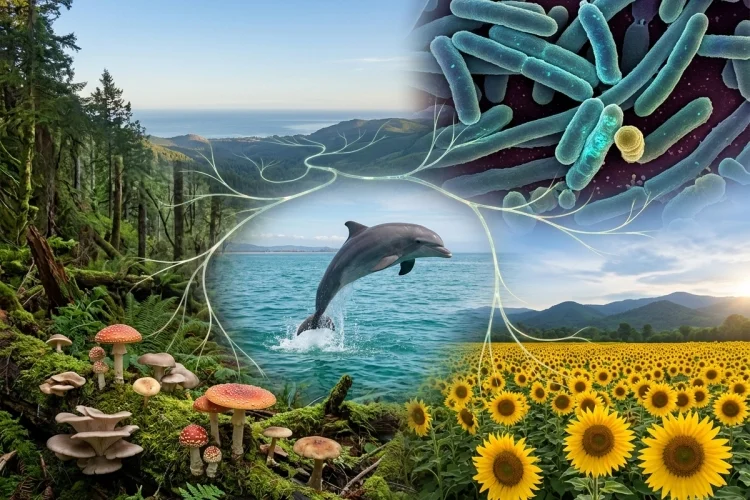
Look at a mushroom, a dolphin, a sunflower, and a microscopic bacterium. They may seem completely unrelated, yet all of them belong somewhere within the enormous diversity of life on Earth. To make sense of that diversity, scientists organize organisms into groups.
Understanding how living things are grouped by their shared features is an important part of biology. Scientists compare characteristics such as cell structure, body form, reproduction, metabolism, and genetic information.
Modern classification also places strong emphasis on evolutionary relationships, helping researchers determine which organisms share common ancestors. The scientific organization and naming of organisms is closely associated with taxonomy.
Traditional taxonomic systems arrange organisms into increasingly specific categories, while modern systematics and phylogenetics use evolutionary evidence to investigate relationships between groups.
Classification is not simply about putting labels on animals and plants. It provides scientists with a shared system for studying, identifying, comparing, and communicating about millions of different forms of life.
So how does the system actually work? Let’s start with the features scientists compare.
1. Scientists Look for Shared Characteristics
Imagine trying to organize a huge collection of objects. You might begin by grouping them according to shape, size, material, or purpose.
Biologists do something similar with living organisms, although biological classification is much more sophisticated.
Scientists can compare observable characteristics such as body structure, types of cells, methods of reproduction, and other biological features.
Historically, similarities and differences in physical form-known as morphology-played an especially important role in classification.
Consider birds.
Although a penguin, eagle, and hummingbird look very different, they share important biological features. They have feathers, for example, even though their lifestyles and body sizes differ dramatically.
Mammals share another collection of characteristics. Plants have features that distinguish them from animals, while fungi possess their own combinations of cellular and nutritional characteristics.
The key idea is that scientists do not normally classify organisms using one random feature. They examine combinations of meaningful characteristics and relationships.
2. Taxonomy Creates an Organized Classification System
The science of naming and organizing organisms is known as taxonomy.
The traditional taxonomic system is hierarchical. This means that broad groups contain increasingly smaller and more specific groups. OpenStax describes the major traditional ranks as domain, kingdom, phylum, class, order, family, genus, and species.
Think of it like organizing files on a computer.
A large folder might contain several smaller folders. Each smaller folder contains increasingly specific information until you eventually reach an individual file.
Biological classification works in a similar way.
For humans, for example, progressively narrower categories eventually lead to the genus Homo and species Homo sapiens. The genus-and-species combination forms part of the binomial naming system used for scientific names.
These standardized names are especially useful because common names can vary between languages and locations.
Scientists around the world can use the same scientific name when referring to the same species.
3. The Three Domains Represent Very Broad Groups
One of the broadest commonly used levels of classification is the domain.
Modern biological classification recognizes three major domains of cellular life:
Bacteria, Archaea, and Eukarya.
The three-domain framework grew from molecular research led by Carl Woese and colleagues.
In 1990, Woese, Otto Kandler, and Mark Wheelis formally proposed the domains Bacteria, Archaea, and Eucarya based on evolutionary relationships revealed particularly through molecular comparisons.
Bacteria and Archaea contain organisms whose cells lack a membrane-bound nucleus. However, molecular evidence revealed that these two groups represent distinct evolutionary lineages rather than one simple group.
Eukarya contains organisms whose cells have nuclei, including animals, plants, fungi, and many other eukaryotic organisms.
You may also see organisms divided into “kingdoms” in textbooks. The exact kingdom-level arrangement can vary among classification schemes, especially for diverse eukaryotic microorganisms.
For beginners, it is therefore more useful to understand the basic idea of hierarchical grouping than to assume that every scientific source uses exactly the same kingdom list.
4. Smaller Groups Share More Specific Features
As you move down the traditional classification hierarchy, the groups become more specific.
Imagine starting with the enormous domain Eukarya. Inside it are many very different organisms.
Moving into smaller taxonomic groups narrows the range.
Eventually, you reach genus and species, two of the most specific commonly taught ranks.
Consider a familiar example from cats.
A house cat and a tiger share many characteristics because both belong to the cat family, Felidae. However, they are not the same species and differ in important anatomical, behavioral, ecological, and genetic characteristics.
This demonstrates a useful principle: organisms placed within increasingly specific groups generally share increasingly specific biological relationships or characteristics.
Classification therefore creates nested groups.
You can imagine several boxes inside one another:
Domain → Kingdom → Phylum → Class → Order → Family → Genus → Species
The system allows scientists to discuss both broad similarities and much closer relationships.
5. Appearance Alone Can Be Misleading
Grouping organisms only by appearance can sometimes cause problems.
Two organisms may look similar because they live in similar environments rather than because they are especially close evolutionary relatives.
For example, organisms can independently evolve features that perform similar functions.
In evolutionary biology, similar traits that arise through separate evolutionary paths are examples of analogy or convergent evolution rather than evidence that the organisms inherited that trait from the same recent ancestor.
That is why modern classification goes beyond asking:
“Do these organisms look alike?”
Scientists also ask:
“What is the evolutionary history behind these features?”
A useful comparison is a bird wing and an insect wing. Both allow flight, but that does not mean birds and insects belong together simply because they have wings.
Scientists need to examine many characteristics and their evolutionary origins before deciding what relationships the similarities actually represent.
6. Evolutionary Relationships Have Become Central to Classification
Modern biological classification is closely connected with phylogeny, which describes the evolutionary history and relationships among organisms.
Scientists often represent these relationships using a phylogenetic tree. Branches represent evolutionary lineages, while branching points represent inferred common ancestry.
Imagine three species-A, B, and C.
If A and B share a more recent common ancestor with each other than either shares with C, a phylogenetic tree will show A and B joining on a more recent branch.
This approach changes the way we think about classification.
The goal is not simply to create boxes of organisms that happen to look similar. Scientists increasingly aim to identify groups that reflect actual evolutionary ancestry.
A group containing a common ancestor and its descendants is commonly called a clade. Modern cladistic and phylogenetic methods allow scientists to test hypotheses about how different organisms are related.
This makes classification part of our broader understanding of evolution.
7. DNA Provides Powerful Evidence About Relationships
One of the biggest changes in biological classification came from molecular biology.
Scientists can compare DNA, RNA, and protein sequences from different organisms. Similarities and differences in those sequences provide evidence that can be used to reconstruct evolutionary relationships.
This can reveal connections that are difficult to identify from appearance alone.
The development of molecular phylogeny played a particularly important role in recognizing the deep distinction between Bacteria and Archaea.
Early comparisons of ribosomal RNA sequences helped reveal that cellular life contains three major evolutionary lineages rather than fitting neatly into the older prokaryote-versus-eukaryote picture.
Modern biological databases now organize enormous amounts of genetic information using taxonomic classifications. The U.S. National Center for Biotechnology Information maintains a curated taxonomy covering organisms represented in public sequence databases.
This means classification and genetics increasingly work together.
As scientists sequence more organisms, evolutionary trees can be tested, refined, and sometimes reorganized.
8. Classification Can Change When New Evidence Appears
Students sometimes imagine scientific classification as a permanent list created long ago.
It is actually a scientific model, and models can change when better evidence becomes available.
Historically, classification depended heavily on visible anatomy. Today, researchers can combine morphology with genetics, cellular biology, fossils, development, and other forms of evidence.
The history of the three-domain system provides a good example. Molecular comparisons revealed an unexpectedly deep evolutionary separation between Bacteria and Archaea, changing scientists’ understanding of life’s largest divisions.
Taxonomic revisions are therefore not signs that classification has “failed.”
They show science working as intended.
New data may reveal that two organisms once considered close relatives are actually more distantly related. Alternatively, genetic evidence may uncover a relationship that was difficult to recognize from anatomy alone.
Modern taxonomy continues to develop as new species are described and new biological information becomes available.
9. Classification Helps Scientists Study Biodiversity
Why spend so much effort organizing living things?
Because classification gives biology a common language.
A structured naming system helps researchers identify organisms, compare discoveries, organize biodiversity information, and connect biological datasets.
The Integrated Taxonomic Information System, for example, provides taxonomic information intended to help biodiversity data be discovered and connected.
Classification can also help scientists examine ecological and evolutionary patterns.
If closely related species share a particular feature, researchers can investigate whether that trait was inherited from a common ancestor.
Taxonomy is also important when scientists document biodiversity. Before researchers can effectively discuss where a species lives, how its population is changing, or how it interacts with an ecosystem, they need to know which organism they are actually talking about.
This is why classification is much more than a memorization exercise.
It is one of the organizational systems that allows biologists to study the diversity and history of life.
Understanding how living things are grouped by their shared features gives us a clearer picture of the enormous diversity of life on Earth.
Scientists examine physical characteristics, cell structures, biological processes, and increasingly molecular evidence such as DNA and RNA to investigate relationships among organisms.
Traditional taxonomy organizes organisms through ranks such as domain, phylum, class, family, genus, and species, while modern phylogenetics focuses strongly on evolutionary ancestry.
As new evidence appears, classifications can change to better reflect what scientists know about the tree of life.
The next time you see two different organisms, compare them carefully. Look at their body structures, habitats, cells, or behaviors and ask what they might share-and whether those similarities could reveal a deeper biological relationship.
Classification begins with noticing patterns, but ultimately it helps us understand how life is connected.