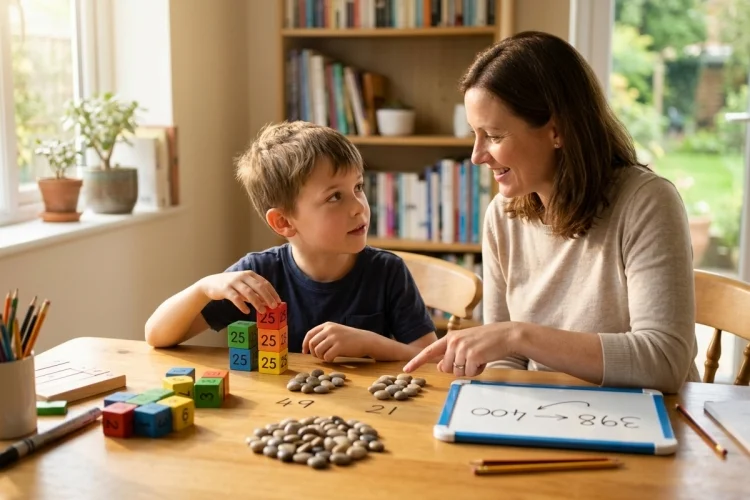
Some students can calculate an answer correctly but still feel unsure about whether that answer makes sense.
Others quickly notice that 49 + 21 should be close to 70, recognize that 75 is three groups of 25, or understand that 398 is only two away from 400. That flexible feeling for numbers is often described as number sense.
Learning how to build strong number sense through daily practice is not simply about memorizing more addition or multiplication facts. It involves understanding quantities, number relationships, place value, operations, estimation, and different ways of solving problems.
The National Council of Teachers of Mathematics emphasizes understanding numbers, different ways to represent them, relationships among numbers, and the meanings of operations as central parts of number and operations learning.
The good news is that number sense does not require hours of worksheets every day. Short, meaningful activities can help students become more comfortable thinking flexibly about numbers.
Here are practical ways to make number sense part of everyday learning.
1. Spend Time Thinking About Numbers, Not Just Calculating
Mathematics can sometimes become a race to find the correct answer.
But number sense grows when students also think about why an answer works.
Consider:
18 + 7
One student might count forward seven times.
Another might think:
18 + 2 = 20
20 + 5 = 25
Both can reach 25, but the second strategy uses the structure of numbers.
Students should have opportunities to discuss these different approaches. NCTM has long emphasized that number sense includes understanding numerical relationships and using properties of operations flexibly rather than relying only on fixed procedures.
A simple daily habit is to solve one calculation in two different ways.
For example:
36 + 19
You might calculate:
36 + 20 − 1 = 55
Or:
30 + 10 + 6 + 9 = 55
Comparing methods encourages flexible mathematical thinking.
2. Strengthen Understanding of Place Value
Place value is one of the foundations of strong number sense.
A student should understand that the 5 in 54 represents five tens, while the 5 in 504 represents five hundreds.
This understanding becomes especially important when students begin working with larger numbers, decimals, addition, subtraction, multiplication, and division.
NRICH notes that developing a strong understanding of ten and place value supports later mental calculation and broader number sense.
Try asking short daily questions such as:
“What is 10 more than 347?”
“What is 100 less than 825?”
“Which number is larger: 3,405 or 3,450?”
You can also ask students to break numbers apart.
For example:
472 = 400 + 70 + 2
Then rearrange it:
472 = 300 + 172
The second representation helps students see that numbers can be decomposed in different useful ways.
That flexibility becomes extremely valuable during mental arithmetic.
3. Practice Estimation Before Finding Exact Answers
Estimation is one of the easiest ways to strengthen number sense.
Before solving a calculation exactly, ask what a reasonable answer should look like.
Consider:
198 + 304
Before calculating, you could think:
200 + 300 ≈ 500
So the exact answer should probably be close to 500.
Now calculate:
198 + 304 = 502
The estimate acts as a quick reality check.
This becomes even more useful with multiplication:
31 × 19
Round mentally:
30 × 20 = 600
If your calculator later displays 5,890, you immediately know something has gone wrong.
Number sense includes estimation and judging whether numerical answers are reasonable rather than accepting calculations automatically. NCTM’s number-and-operations framework emphasizes flexible computation and understanding how operations relate to numbers.
Use estimation during shopping, cooking, traveling, and homework.
The more often students predict approximate answers, the stronger their instinct for numerical size becomes.
4. Build Mental Math Strategies
Mental math is not about solving enormous calculations entirely in your head.
It is about recognizing efficient ways to work with numbers.
For example:
25 + 38
Instead of counting upward, think:
25 + 40 − 2 = 63
For:
16 × 5
You might think:
10 × 5 = 50
6 × 5 = 30
50 + 30 = 80
Or:
16 × 10 = 160
160 ÷ 2 = 80
NRICH encourages activities where students compare calculation strategies and think about which approach is most efficient rather than focusing only on the final answer.
Ask “How Did You Work It Out?”
This may be one of the most useful questions in mathematics.
When a student gives the correct answer, do not immediately move on.
Ask:
“How did you know?”
A student might reveal a clever relationship that other learners had not noticed.
Explaining strategies also helps students become more aware of their own mathematical thinking.
5. Learn Number Bonds and Useful Relationships
Certain number relationships appear constantly in mathematics.
Knowing that:
7 + 3 = 10
6 + 4 = 10
8 + 2 = 10
makes many larger calculations easier.
For example:
47 + 6
A student who recognizes number bonds can think:
47 + 3 = 50
50 + 3 = 53
Relationships around 10, 20, 50, and 100 are particularly useful.
Try asking:
“What goes with 37 to make 100?”
A student might think:
37 + 63 = 100
Then try related questions:
370 + ? = 1,000
3.7 + ? = 10
Students begin to see mathematical patterns rather than treating every problem as completely new.
NRICH provides number-sense activities involving pairs, combinations, mental calculations, and relationships among quantities precisely to encourage this type of flexible thinking.
6. Use Objects and Visual Representations
Numbers can feel abstract, especially for younger learners.
Physical objects can make quantities easier to understand.
abstract, especially for younger learners.
Physical objects can make quantities easier to understand.
Ten buttons can be arranged into two groups of five. Twelve counters can form three groups of four. Twenty blocks can be separated into different combinations.
The Education Endowment Foundation highlights the value of manipulatives when they help learners connect concrete experiences with abstract mathematical idxploration can support movement toward mathematical fluency.
A student exploring 12 could arrange counters as:
6 + 6
10 + 2
3 groups of 4
4 groups of 3
The number has not changed, but the representation has.
That is number sense in action.
Number lines, ten frames, counters, blocks, drawings, and simple household objects can all make useful mathematical relationships visible.
7. Turn Everyday Situations Into Number Practice
Number sense does not need to remain inside a mathematics lesson.
Daily routines offer plenty of opportunities.
At the supermarket, estimate the total price of several items before reaching the checkout.
During cooking, discuss doubling or halving a recipe.
While traveling, estimate how long a journey might take.
If a bus arrives every 15 minutes, ask when the next few buses might appear.
The Education Endowment Foundation encourages integrating mathematical thinking into everyday routines, especially for younger learners, because ordinarrtunities to discuss quantity, comparison, patterns, and mathematical language.
IES resources for families similarly recommend inclliar activities such as daily routines and trips to places like grocery stores.
These conversations show students that numbers are tools for understanding real situations, not just symbols printed on worksheets.
8. Play Simple Number Games
Practice does not always need to feel like practice.
Dice, cards, dominoes, number puzzles, and board games can create repeated opportunities to compare quantities and calculate mentally.
For example, roll two dice.
Instead of simply adding them, ask:
“What is the sum?”
“What is the difference?”
“What would you add to reach 20?”
“What happens if you multiply them?”
A single roll can generate several mathematical questions.
NRICH provides many number and mental-calculatiober combinations, possible answers, and efficient strategies.
The advantage of games is repetition with variation.
Students may practice similar mathematical ideas many times, but each round feels slightly different.
The Education Endowment Foundation also notes that repeated practice can support in meaningful and motivating contexts rather than becoming mindless repetition.
9. Compare Numbers Regularly
Strong number sense includes knowing how quantities relate to one another.
Ask students which number is greater and, more importantly, how much greater.
For example:
Which is larger?
68 or 86?
That question is easy.
Now ask:
“How much larger is 86 than 68?”
Students must think more carefully about the distance between the numbers.
Number lines are particularly helpful here.
You can also ask students to place numbers approximately:
“Where would 47 go between 0 and 100?”
“Where would 750 go between 500 and 1,000?”
IES mathematics guidance recommends using visual representations, as part of instruction for students who need additional support in mathematics.
These activities help learners develop a stronger sense of magnitude.
10. Keep Daily Practice Short but Meaningful
Building number sense does not require completing 100 nearly identical calculations every evening.
Ten focused minutes can be more useful when students actually think about relationships.
A simple routine might include:
One mental calculation.
One estimation question.
One “Which number is greater?” challenge.
One number puzzle.
One explanation of how an answer was found.
The What Works Clearinghouse recommends teaching number and operations throughlding mathematical understanding as students’ skills develop.
The difficulty should therefore grow gradually.
A learner working confidently with numbers to 20 may begin exploring numbers to 100. Someone comfortable with whole numbers can apply similar thinking to fractions, decimals, percentages, and negative numbers.
The goal is steady development, not rushing ahead.
Learning how to build strong number sense through daily practice is about helping numbers become meaningful rather than simply memorized.
Students benefit from exploring place value, estimation, mental math, number bonds, visual models, comparisons, and different calculation strategies.
Everyday situations can make this learning even more natural. Shopping, cooking, games, travel, and simple conversations all provide opportunities to think mathematically.
Most importantly, encourage students to explain how they reached an answer. A correct result matters, but understanding the relationships behind that result builds much deeper mathematical confidence.
Start small today. Choose one number, break it apart in several ways, estimate a calculation, or solve one problem using two strategies.
A few minutes of thoughtful number practice every day can gradually make mathematics feel much more flexible and familiar.