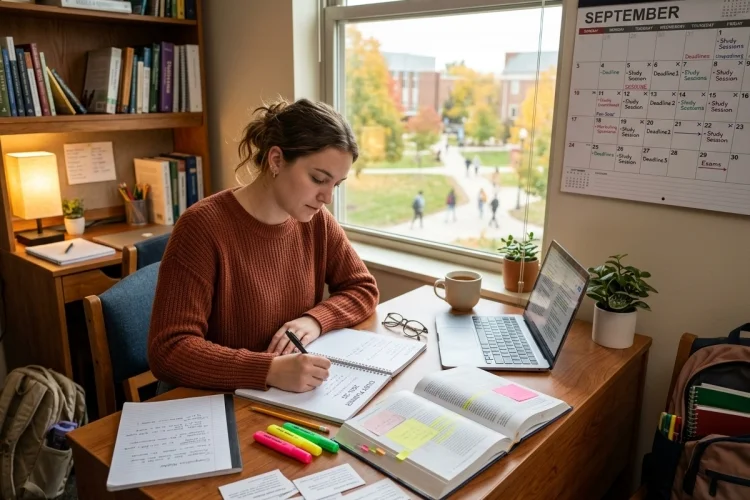
Starting a new school year often comes with plenty of motivation. You buy new notebooks, organize your desk, create an ambitious study schedule, and promise yourself that this time you will stay ahead of everything.
Then a few busy weeks arrive, assignments pile up, and those perfect routines quietly disappear. That is exactly why learning how to build better study habits matters more than creating an impressive study plan for the first week of class.
Good habits are not about studying for hours every day. They are about creating simple routines that are realistic enough to repeat even when life gets busy.
Research on learning also suggests that methods such as spaced practice and retrieval practice are generally more effective for long-term learning than relying heavily on last-minute cramming or passive review.
The goal, then, is not to become the “perfect student.” It is to build a study system that continues working in September, January, and even during stressful exam weeks.
1. Start With Small and Realistic Study Habits
One of the biggest mistakes students make is trying to change everything at once. Someone who rarely studies outside class might suddenly plan three-hour study sessions every evening. That schedule may look productive, but it is difficult to maintain.
Instead, start with something small enough to repeat consistently. You might spend 20 minutes reviewing your notes after dinner or answer five practice questions before checking social media.
Habit research suggests that automatic behaviors develop through repeated actions in a consistent context rather than appearing after a fixed number of days.
In one widely cited study, participants repeated everyday behaviors in the same context for several weeks, with habit development varying considerably between individuals.
Attach Studying to an Existing Routine
A simple way to improve consistency is to connect studying with something you already do.
For example, instead of saying, “I will study chemistry every day,” try, “After dinner, I will review chemistry for 20 minutes.”
The second version gives your brain a clear cue. Over time, beginning the study session requires less decision-making.
2. Create a Weekly Study Schedule You Can Actually Follow
A useful schedule should reflect your real life rather than your ideal life.
Start by adding fixed commitments such as classes, work, meals, sports, commuting, and family responsibilities. Then place focused study blocks into the remaining time.
The University of North Carolina Learning Center recommends regularly planning the week ahead so students can distribute work and avoid unexpected piles of assignments.
Do not fill every available hour. Leave some flexibility for unexpected homework, difficult topics, appointments, or simply having a bad day.
For example, three focused 30-minute sessions during the week may be more sustainable than promising yourself a four-hour Saturday study marathon.
A good schedule reduces the daily question of “When should I study?” You already know when the work is supposed to happen.
3. Use Spaced Practice Instead of Cramming
Cramming can create the feeling that you are learning quickly because the information is fresh in your mind. Unfortunately, remembering something tonight does not necessarily mean you will remember it next month.
Spaced practice means reviewing material across multiple sessions rather than squeezing everything into one long session.
Cornell University’s Learning Strategies Center describes spaced practice as studying material at intervals, which supports better learning and retention compared with cramming.
Imagine you have a biology exam in three weeks. Instead of waiting until the final weekend, you could review one section today, revisit it several days later, test yourself the following week, and complete another review shortly before the exam.
The total amount of study time does not necessarily need to become dramatically longer. You are simply distributing that time more effectively.
This approach also makes studying less stressful because exam preparation becomes part of your normal routine rather than an emergency.
4. Make Your Study Sessions More Active
Spending an hour looking at a textbook is not automatically the same as learning for an hour.
Active learning requires you to do something with the information. One particularly useful strategy is retrieval practice, which means trying to bring information back from memory without immediately checking your notes.
Cornell recommends activities such as starting with a blank page and writing down everything you remember about a topic. The process can reveal both what you understand and what still needs more work.
You can also close your textbook and explain a concept aloud, create your own questions, solve problems without looking at examples, or use flashcards.
Try the “Teach It” Test
After studying something, imagine that a friend asks you to explain it.
Can you describe the idea clearly without checking your notes?
If you suddenly struggle, that is useful information. You have discovered a gap in your understanding before the exam discovers it for you.
5. Protect Your Study Time From Digital Distractions
You might sit at your desk for two hours while only getting 40 minutes of meaningful studying done.
Notifications, messages, short videos, and constantly changing browser tabs can repeatedly interrupt concentration.
UNC recommends practical strategies such as turning off notifications, closing unnecessary apps and websites, or placing your phone in another room while working.
You do not have to completely abandon technology. The idea is to make distraction slightly more difficult.
If checking your phone requires standing up and walking across the room, you are less likely to do it automatically every few minutes.
You can also create focused study blocks. Work for around 25–50 minutes, then take a short break before starting another session. The exact timing is less important than having periods when studying is the only activity you are doing.
6. Review Your Progress Instead of Just Tracking Hours
Students often measure productivity by asking, “How long did I study?”
A better question is, “What can I do now that I could not do before?”
The UNC Study Cycle recommends regularly checking whether your learning methods are actually working. Students can self-test, discuss concepts with classmates, review learning objectives, and adjust ineffective strategies.
Suppose you studied mathematics for three hours but still cannot solve problems without looking at the solution. More time using the same method may not fix the problem.
Instead, change the method. Practice easier problems first, identify the step causing difficulty, ask your teacher for clarification, or study with a classmate.
Effective study habits are flexible. The habit is not blindly following the same routine forever. The habit is regularly learning, checking your understanding, and adjusting.
7. Treat Sleep and Breaks as Part of Studying
When deadlines arrive, sleep is often the first thing students sacrifice.
That can work against learning. NIH research summaries explain that sleep before learning helps prepare the brain to form new memories, while sleep afterward helps strengthen newly learned information. Sleep deprivation can significantly reduce the brain’s ability to learn new material.
Instead of viewing sleep as time taken away from studying, think of it as part of the learning process.
Breaks matter too. Long periods of nonstop studying can lead to declining attention and mental fatigue. Short periods of rest give you an opportunity to reset before returning to difficult work.
A sustainable study routine should therefore include study sessions, sleep, meals, movement, relaxation, and time with other people.
If your study system requires you to be exhausted all year, it is probably not a good system.
8. Learn How to Recover When Your Routine Breaks
Even strong study habits will occasionally fall apart.
You may get sick, travel, have several deadlines at once, or simply spend a week procrastinating. The mistake is believing that one bad week means your entire routine has failed.
Avoid the “I’ll start again next Monday” mindset.
Restart with the smallest possible action. Review one page tonight. Complete ten minutes of practice. Organize tomorrow’s assignments. Then continue from there.
Consistency does not mean never missing a study session. It means returning to your routine instead of allowing one missed session to become several weeks of avoidance.
That ability to restart may be one of the most valuable study skills you can develop.
Learning how to build better study habits that last all year is less about motivation and more about creating a system that works during ordinary days.
Small routines, weekly planning, spaced practice, retrieval practice, fewer digital distractions, regular self-testing, and adequate sleep can make studying both more effective and more manageable.
You do not need to transform your entire routine overnight. Choose one improvement and practice it consistently. Maybe you review notes for 20 minutes after class, put your phone away during study sessions, or start preparing for exams several days earlier.
Once that habit feels natural, add another.
Start small today. The best study routine is not the most complicated one-it is the one you can keep using throughout the year.